Sourcing
How to Source Obsolete and Discontinued Industrial Parts
When a manufacturer discontinues a part, the machine does not stop needing it. Here is a structured way to find obsolete parts or a safe alternative.
Machines and their components come from many countries. Here is how an international network of manufacturers, distributors and stock holders helps find a part.
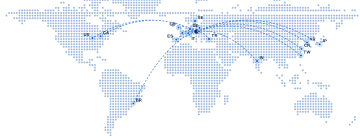
A typical production hall is a small world exhibition. The press may come from Germany, the CNC machine from Japan, the packaging line from Italy and the controls from yet another country. When one of these machines needs a spare part, the search often has to be just as international. At LiteHard we work with many manufacturers and distributors around the world, and this article explains why that matters and how the process works.
Industrial machinery is built in many countries. Germany, Japan, Italy, Switzerland, the USA, Taiwan, South Korea and China are among the well-known machine building nations, and there are strong specialized builders in many others. The map above gives an idea of how widely spread the sources are.
The machine builder is only the first layer. Each machine is assembled from components made by other companies:
These components may come from suppliers in dozens of countries, and their part numbers often follow the component maker's system rather than the machine builder's. Over a machine's long life, things change: suppliers merge, product lines are discontinued, distributors change territory and regional versions of the same part appear under different numbers. A part that is easy to buy in one country can be unavailable in another, and the last remaining stock of an obsolete item can sit in a warehouse on the other side of the world.
Finding a part means knowing where to look. The main sources are:
Each source has its strengths. An authorized distributor offers traceability, while a surplus holder may have the only remaining units of a discontinued model. Knowing which type of supplier fits which situation, and checking origin and condition carefully, is part of avoiding counterfeit parts.
A single plant purchasing department usually knows its local distributors well. Going beyond that takes time and contacts. An international network helps in several ways.
Searching across many regions at once increases the chance of finding the exact part, an approved successor or a suitable cross-reference. Regional variants and alternative part numbers can be checked with the right suppliers. Our guide on cross-referencing part numbers explains how equivalents are identified.
When a supplier in Asia replies overnight and another in North America replies in the evening, a search can progress around the clock. Coordinating and comparing these replies is work a sourcing agency takes off your desk.
Suppliers respond faster and more precisely when they are approached in a way they understand, with complete technical data. Regional habits around quotes, payment terms and minimum orders also differ.
When several sources respond, offers can differ in condition (new, new old stock, remanufactured), documentation, delivery terms and Incoterms. Putting them into one clear quote makes the decision easier for the customer.
International purchases need commercial invoices, origin information, correct customs descriptions and sometimes export checks. Coordinating shipping, tracking and paperwork reduces the risk of delays at the border. See importing spare parts for the customs side.
Tip: The more complete your request, the better the network can work. Nameplate data, the exact part number and a few clear photos often make the difference between a quick match and a long search.
Our process is simple and the same for every request.
We are a sourcing agency, not a manufacturer and not a repair shop. That means we do not hold a catalog of our own stock and we cannot promise in advance that every part will be found. Some parts are genuinely gone from the market, and in those cases the honest answer is to say so and, where possible, point to alternatives such as a successor model, a cross-reference or remanufacturing.
A wider search is worth considering when:
You can request a part with whatever information you have, even if it is incomplete.
Send us what you know about it: part number, machine nameplate, photos or a drawing. We search manufacturers, distributors and stock holders worldwide and send you a quote when we find it.
Request a partWhen a manufacturer discontinues a part, the machine does not stop needing it. Here is a structured way to find obsolete parts or a safe alternative.
The nameplate is the fastest route to the right spare part. Learn what each field means and what to send so a supplier can identify the part the first time.
An equivalent part can save days of downtime, or cause a new failure. Learn how to cross-reference part numbers safely and which details to check.